The debate about artificial intelligence has gained traction recently. Many students use it frequently but may be unaware how it impacts their creativity. They may also be unaware of the impact it has over their feelings of authorship after prompting the AI.
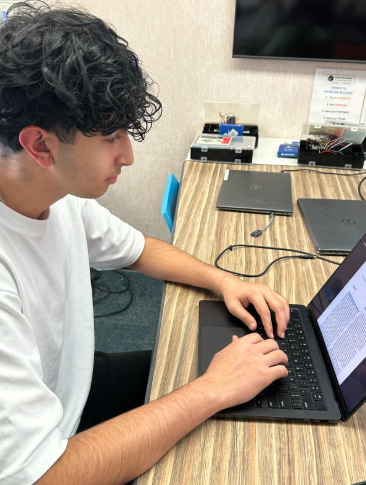
Pranil Raichura, a junior at Granite Bay High School who is passionate about AI and computer science, created a notable research paper about these topics. Though it was originally a project for DE Psychology, it transformed into something Raichura plans to continue until ultimately other communities see his research.
The rise of AI usage for students interested Raichura because he wanted to know how students felt about it regarding creativity and authorship. For example, Raichura wanted to know if students felt they had more or less authorship when they prompted the AI to do something.
While some results did not come as a surprise to Raichura, other results did. Some of the results he saw from his data surprised Raichura.
“AI use is slightly positively correlated with feeling authorship over it. So that surprised me a little bit, because that basically means that students who use AI more at school, they feel slightly more ownership over their work, as if they own it themselves,” Raichura said.
As for what Raichura plans for this piece, he is working on the process of getting it printed, with hopes of publishing it for some form of scientific journal.
“I plan to publish this in the future. So right now, I’m currently pre-printing it,” Raichura said.
In addition to this, teachers are impressed with the results of the study and believe that it could be used as a way to give their students an idea of how AI usage directly affects them. Primarily in an attempt to teach how to use AI responsibly.
Mrs. Shannon McCann, an AP Language and Composition teacher at GBHS, uses AI in her classes as a way for students to revise but believes it is seriously flawed and responsibility should play a big role in the usage of it, since there is not much course material on it.
“Teachers have had trainings on how to use it, but there’s really no courses on the ethics of AI [such as] how AI is using our data [or]
just how to use it responsibly. I think that it feels like [AI] happens so fast in workplaces and schools [that] we’re not really prepared to use it.,” McCann said.
Many people also believe that AI is a new vitality to society and improvements made upon it will be highly useful and effective in the future. Marc Imrie, the computer science teacher at GBHS, believes understanding AI is a vital concept and will be highly beneficial to people in the future.
“It will be in everything that we do, in our daily lives, our personal lives, our careers, academics and those who understand it and how to utilize it effectively will have great opportunities in society,” Imrie said.
Research done by students helps other students to consider the subject relevant and creates a general interest in a topic. Raichura’s research took a topic that is relevant in today’s world and made the research more applicable to students.
“Students know what you all are going through and see the world through your lens. And so I think student-led research and student driven questions can be more relevant, or at least more accepted,” Imrie said.